
Why IntellxxDNA? How Clinical Genomics Is Transforming Brain Health, Cognitive Recovery, and Precision Medicine
Last Updated: August 2026
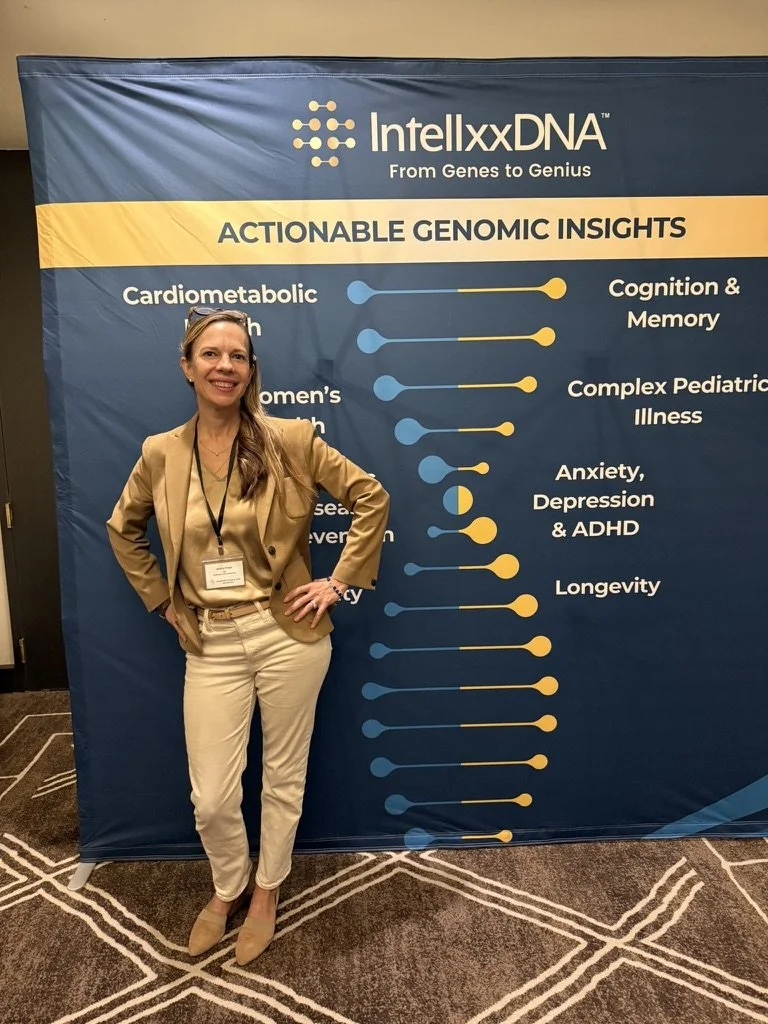
When I first began incorporating clinical genomics into my medical practice, I viewed genetics the same way many physicians do: as a way to estimate risk.
Would someone develop heart disease?
Were they predisposed to diabetes?
Did they carry the APOE4 gene associated with Alzheimer's disease?
Those questions are important, but they're incomplete.
Genes are not destiny.
Genes are information.
And the value of that information lies not in prediction, but in interpretation.
At HealthSpan Internal Medicine in Boulder, Colorado, we've moved beyond the traditional view of genetics as a static report card. Instead, we use clinical genomics as a dynamic tool that helps us understand why patients become ill, why certain treatments fail, and how to develop highly personalized strategies for recovery.
One of the most powerful tools we've incorporated into our Brainspan Blueprint™ programs is IntellxxDNA, a clinical genomics platform that translates complex genetic data into practical, actionable medical insights.
Recently, I had the opportunity to present at the IntellxxDNA Conference, where I shared a lecture entitled "The Canary Sings Again: A Neuroinflammatory Perfect Storm Recovery Story."
The case illustrated something I've observed repeatedly throughout my years of caring for patients with cognitive decline, complex chronic illness, and neuroinflammatory disorders:
The most difficult neurological cases often teach us the most about human biology.
Like a canary in a coal mine, the brain frequently becomes the first organ to signal that something is wrong.
And if we're willing to listen, those signals can reveal an extraordinary amount about inflammation, toxins, metabolism, mitochondrial function, immune regulation, and the remarkable resilience of the human nervous system.
1. What Is IntellxxDNA?
IntellxxDNA is a clinical genomics platform designed to help healthcare practitioners interpret genetic information in a clinically meaningful way.
Unlike direct-to-consumer genetic tests that provide long lists of variants without context, IntellxxDNA organizes genetic information into functional pathways that physicians can use to guide decision-making.
The platform evaluates genes involved in:
Neurotransmitter production
Inflammation
Detoxification
Methylation
Mitochondrial function
Oxidative stress
Hormone metabolism
Immune regulation
Cardiovascular health
Cognitive resilience
Rather than simply identifying whether a genetic variant exists, IntellxxDNA asks a more clinically useful question:
How might this genetic pattern influence physiology?
2. Genes Load the Gun, but Environment Pulls the Trigger
One of the biggest misconceptions about genetics is the belief that genes determine our future.
In reality, genes often represent susceptibility, not certainty.
Consider two patients with identical genetic risk factors.
One develops cognitive decline in their sixties.
The other remains cognitively healthy into their nineties.
Why?
Because genetics interact continuously with:
Nutrition
Sleep
Stress
Toxin exposure
Physical activity
Hormones
Infections
Social connection
This interaction between genes and environment is known as epigenetics.
Our goal isn't to change someone's DNA.
Our goal is to change the environment in which that DNA is expressed.
3. Why Neurological Disease Reveals So Much About Inflammation
The brain is extraordinarily sensitive.
Although it represents only about 2% of body weight, it consumes approximately 20% of the body's energy.
That high metabolic demand makes the brain particularly vulnerable to:
Oxidative stress
Inflammation
Hypoxia
Toxin exposure
Nutrient deficiencies
Mitochondrial dysfunction
When patients develop memory problems, brain fog, chronic fatigue, sensory sensitivity, or cognitive decline, these symptoms often represent the earliest signs of a much larger systemic problem.
This was one of the central messages of my conference presentation.
Complex neurological cases don't just teach us about the brain.
They teach us about the entire body.
4. "The Canary Sings Again": A Neuroinflammatory Perfect Storm

Canaries were once used in coal mines because they were extremely sensitive to toxic gases.
If the canary stopped singing, miners knew danger was present.
In many ways, the brain functions exactly the same way.
Brain fog.
Memory loss.
Anxiety.
Depression.
Fatigue.
Sleep disruption.
Difficulty concentrating.
These symptoms are often the brain's warning signals.
In the case I presented, cognitive symptoms weren't caused by a single diagnosis.
Instead, they emerged from a perfect storm of interacting factors.
These included:
Inflammation
Environmental toxicity
Immune dysregulation
Metabolic dysfunction
Impaired detoxification
Mitochondrial stress
No single laboratory test could explain the entire clinical picture.
Only by understanding the interactions among these systems could we identify a meaningful path toward recovery.
5. What Can Dementia Teach Us About Chronic Inflammation?
Traditionally, Alzheimer's disease has been viewed as a disorder of amyloid plaques and tau tangles.
However, modern research suggests that these pathological changes may represent only part of the story.
Increasing evidence implicates:
Neuroinflammation
Insulin resistance
Vascular dysfunction
Chronic infections
Toxin exposure
Mitochondrial dysfunction
The brain doesn't become inflamed in isolation.
Inflammation is a systems-wide process.
Many of the same biological patterns observed in Alzheimer's disease also appear in patients with:
Mold illness
Lyme disease
Long COVID
Autoimmune disorders
Chronic fatigue syndrome
Metabolic syndrome
Understanding these overlapping mechanisms helps us recognize opportunities for intervention much earlier.
6. Inflammation Is Highly Individual
Two patients can be exposed to the same environmental toxin and experience completely different outcomes.
Why?
Because their genetic architecture differs.
Some patients possess genetic variants that increase inflammatory responses.
Others have reduced detoxification capacity.
Some demonstrate increased susceptibility to oxidative stress.
Others have alterations in immune signaling pathways.
IntellxxDNA allows us to identify these differences and develop individualized treatment strategies.
7. The Mitochondrial Connection
Every neuron depends on mitochondria.
These microscopic energy-producing structures generate ATP, the molecule that powers neuronal communication.
Mitochondrial dysfunction has been implicated in:
Alzheimer's disease
Parkinson's disease
Multiple sclerosis
Traumatic brain injury
Chronic fatigue
Depression
Clinical genomics can identify genetic variations that influence:
Electron transport
Oxidative phosphorylation
Antioxidant defenses
Cellular energy production
This information allows us to develop targeted interventions.
For example, some patients may benefit from:
CoQ10
Acetyl-L-carnitine
Creatine
Photobiomodulation
Hyperbaric oxygen therapy
Methylene blue
Precision medicine allows us to move beyond generalized recommendations.
8. Detoxification Genes Matter More Than Most People Realize
One of the most fascinating aspects of clinical genomics is understanding detoxification pathways.
Our bodies continuously process:
Environmental chemicals
Heavy metals
Air pollutants
Medications
Hormones
Endogenous metabolic waste
Not everyone performs these tasks equally.
Genes involved in detoxification pathways may influence how efficiently someone processes:
Mold toxins
Mercury
Pesticides
Volatile organic compounds
Combustion byproducts
When detoxification pathways become overwhelmed, neuroinflammation often follows.
The result may look remarkably similar to early cognitive decline.
9. Why Cognitive Decline Requires Personalized Medicine
No two patients with cognitive impairment look exactly alike.
One patient may have:
Insulin resistance
Sleep apnea
Hormone deficiency
Another may have:
Chronic inflammation
Mold exposure
Mitochondrial dysfunction
A third may have:
APOE-related lipid abnormalities
Vascular disease
Impaired methylation
Yet all three may carry the same diagnosis: mild cognitive impairment.
This is why one-size-fits-all approaches often fail.
Precision medicine recognizes that identical symptoms may emerge from very different biological pathways.
10. What Does an IntellxxDNA Evaluation Look Like?
At HealthSpan Internal Medicine, genetic information never exists in isolation.
Instead, we integrate genomics with:
Detailed medical history
Advanced laboratory testing
Nutritional assessment
Hormone evaluation
Cognitive testing
Inflammatory markers
Environmental exposure history
Genetic information becomes one piece of a much larger puzzle.
Importantly, genetic findings do not determine treatment.
They help prioritize which systems deserve closer attention.
11. Who Should Consider Clinical Genomics?
Clinical genomics may be particularly helpful for individuals experiencing:
Brain fog
Mild cognitive impairment
Family history of Alzheimer's disease
Complex chronic illness
Multiple unexplained symptoms
Treatment-resistant conditions
Mold or toxin exposure
Persistent fatigue
Neuroinflammatory symptoms
Genomics can also be valuable for prevention.
Understanding vulnerabilities before symptoms develop creates opportunities to intervene earlier.
12. The Future of Brain Medicine Is Precision Medicine
Medicine is changing.
The future isn't built around finding one pill for every disease.
Instead, it's moving toward identifying the unique biological factors influencing each individual.
Clinical genomics represents one of the most important tools in that transition.
It helps us ask better questions.
Why is inflammation occurring?
Why is detoxification impaired?
Why are mitochondria struggling?
Why is cognition declining?
More importantly, it helps us identify what we can do about it.
13. The Brainspan Summary
If there's one lesson I hope patients take away it's this:
The brain is often the first organ to tell us that something is wrong.
Brain symptoms are rarely random.
They're messages.
And when we listen carefully, those messages often reveal opportunities for healing.
Clinical genomics doesn't predict the future.
It provides a roadmap.
At HealthSpan Internal Medicine, we use tools like IntellxxDNA to translate that roadmap into personalized strategies that support cognitive resilience, reduce inflammation, optimize metabolism, and extend Brainspan.
The canary is still singing.
The question is: are we listening?
References
My Previous Blog: What Is Clinical Genomics and Why Is It Useful for Brain Health?
National Center for Biotechnology Information — Precision Medicine and Alzheimer's Disease
National Institutes of Health — Mitochondria and Neurodegenerative Disease
Medically reviewed by
Dr. Jessica Knape, MD, MA, Board Certified in Internal Medicine and Integrative and Holistic Medicine
Healthspan Internal Medicine — serving patients in Boulder, CO
Book a consultation | Learn More
This content is for educational purposes and does not replace personalized medical advice.
